


Manifesto for Generalism
1. Generalism, is art, for the sake of art.
2. All art is Generalism, unless it is narrower defined in another art movement.
3. Whenever art cannot be explained, or defined by the artist or by somebody else, it will be regarded as Generalism.
4. Therefore Generalism unites all art.
5. The onus, therefore rest on the creator, or observer, to explain, or to prove that a particular piece of art should not be regarded as Generalism.
6. Generalism comes down to the fact, that even if an artist has nothing to say, he/she must say it in order to prevent their work to be classified as Generalism.
Timeline: Abstract Expressionism
On the floor I am more at ease, I feel nearer, more a part of the painting, since this way I can walk around in it, work from the four sides and be literally `in' the painting.
-- Jackson Pollock, 1947.
Pollock, Jackson (1912-56). American painter, the commanding figure of the Abstract Expressionist movement.
He began to study painting in 1929 at the Art Students' League, New York, under the Regionalist painter Thomas Hart Benton. During the 1930s he worked in the manner of the Regionalists, being influenced also by the Mexican muralist painters (Orozco, Rivera, Siqueiros) and by certain aspects ofSurrealism. From 1938 to 1942 he worked for the Federal Art Project. By the mid 1940s he was painting in a completely abstract manner, and the `drip and splash' style for which he is best known emerged with some abruptness in 1947. Instead of using the traditional easel he affixed his canvas to the floor or the wall and poured and dripped his paint from a can; instead of using brushes he manipulated it with `sticks, trowels or knives' (to use his own words), sometimes obtaining a heavy impasto by an admixture of `sand, broken glass or other foreign matter'. This manner of Action painting had in common with Surrealist theories of automatism that it was supposed by artists and critics alike to result in a direct expression or revelation of the unconscious moods of the artist.
Pollock's name is also associated with the introduction of the All-over style of painting which avoids any points of emphasis or identifiable parts within the whole canvas and therefore abandons the traditional idea of composition in terms of relations among parts. The design of his painting had no relation to the shape or size of the canvas -- indeed in the finished work the canvas was sometimes docked or trimmed to suit the image. All these characteristics were important for the new American painting which matured in the late 1940s and early 1950s.
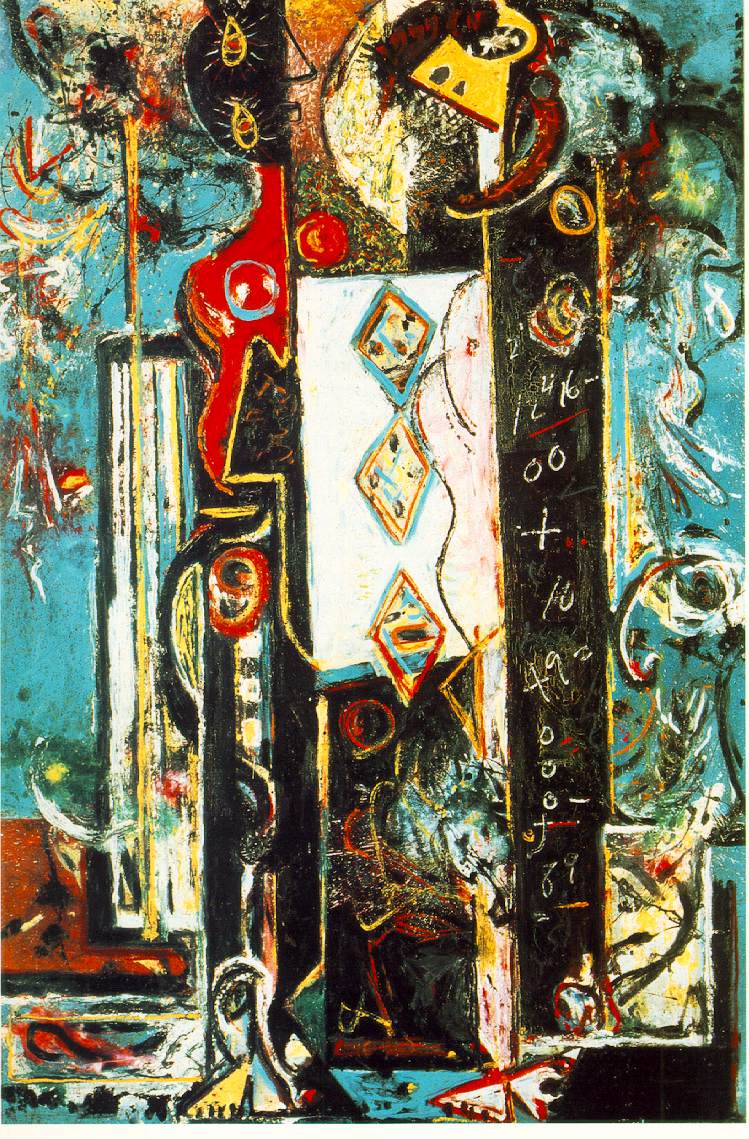
1942 (240 Kb); Oil on canvas, 73 1/4 x 49 in; Philadelphia Museum of Art
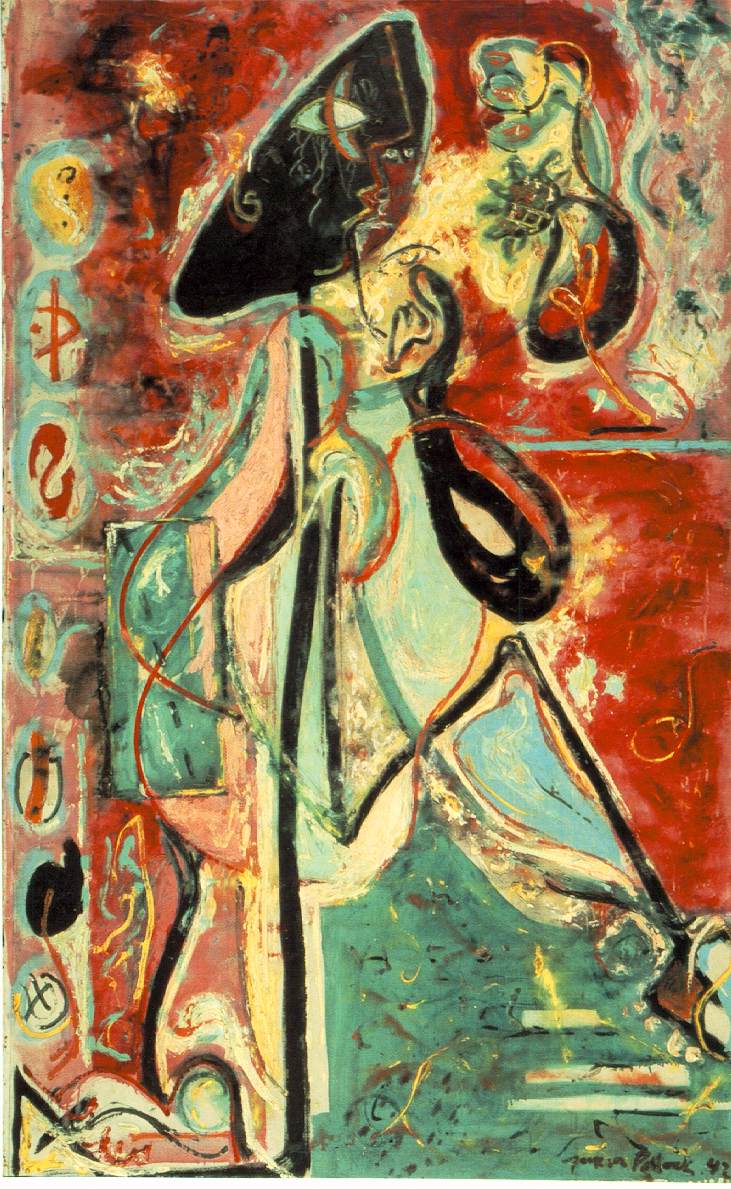
1942 (170 Kb); Oil on canvas, 69 x 43 in; Peggy Guggenheim Collection, Venice
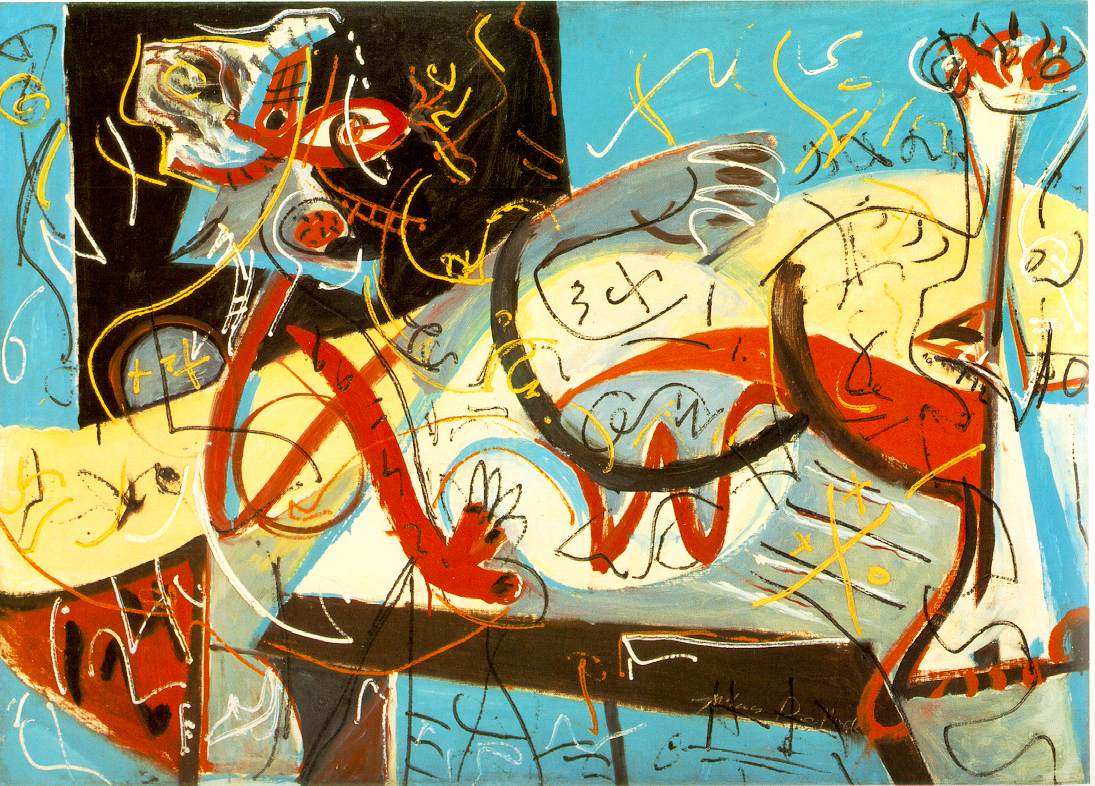
1942 (180 Kb); Oil on canvas, 40 x 56 in; The Museum of Modern Art, New York
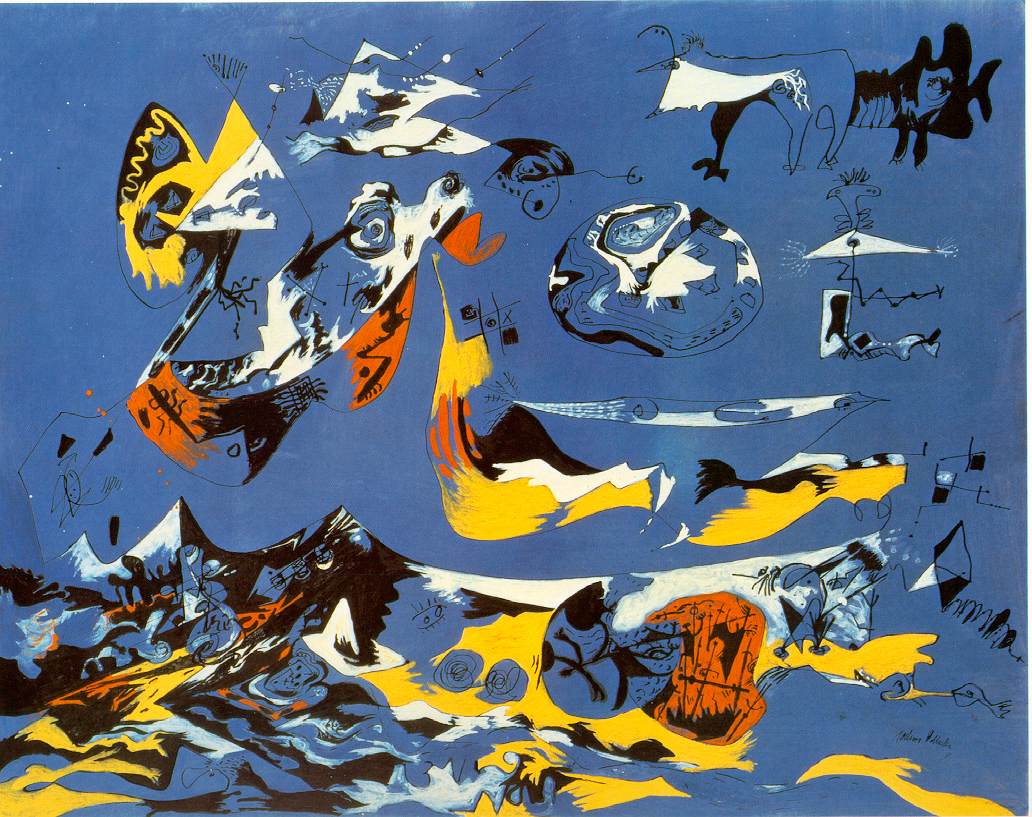
c. 1943 (150 Kb); Gouache and ink on composition board, 18 3/4 x 23 7/8 in; Ohara Museum of Art, Kurashiki
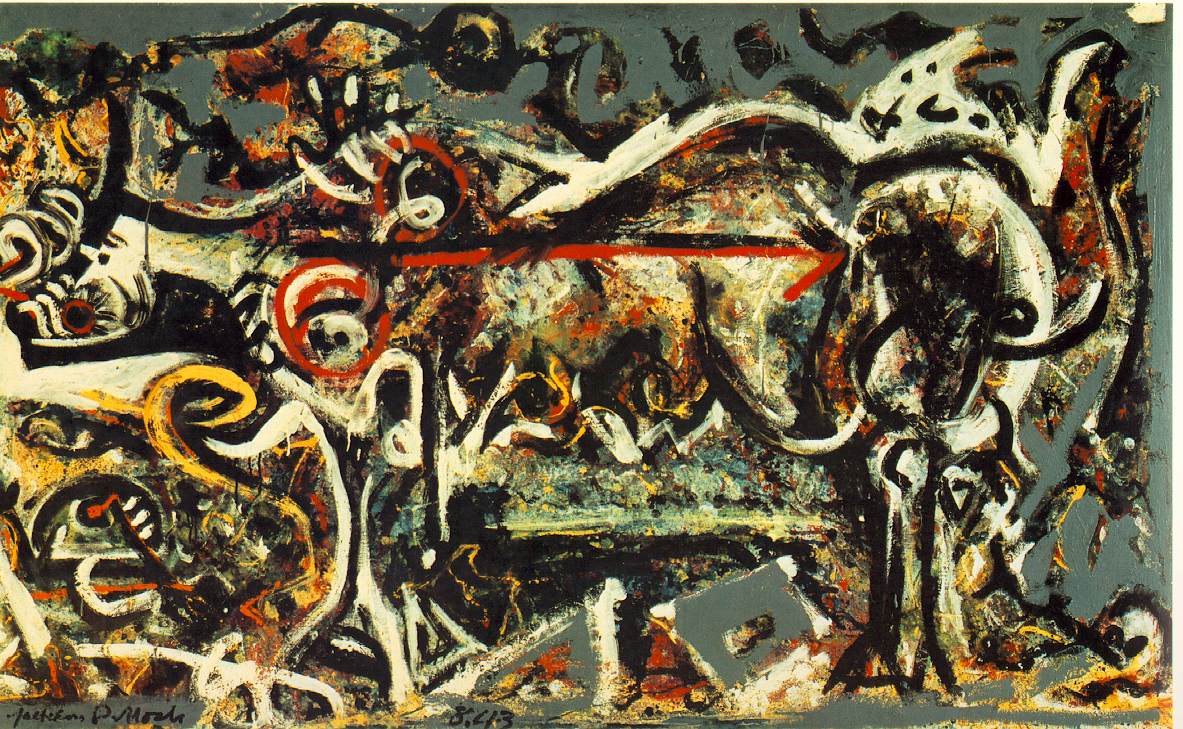
1943 (230 Kb); Oil, gouache, and plaster on canvas, 41 7/8 x 67 in; The Museum of Modern Art, New York
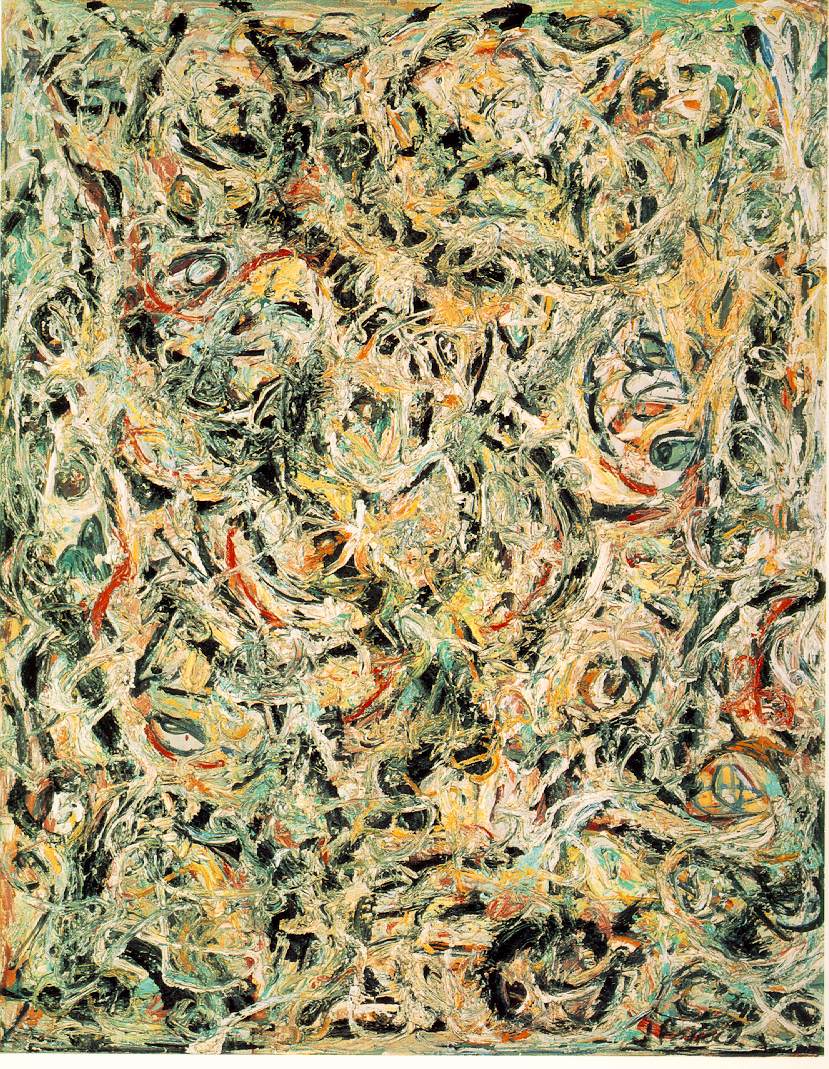
1946 (320 Kb); Oil on canvas, 54 x 43 in; Peggy Guggenheim Collection, Venice
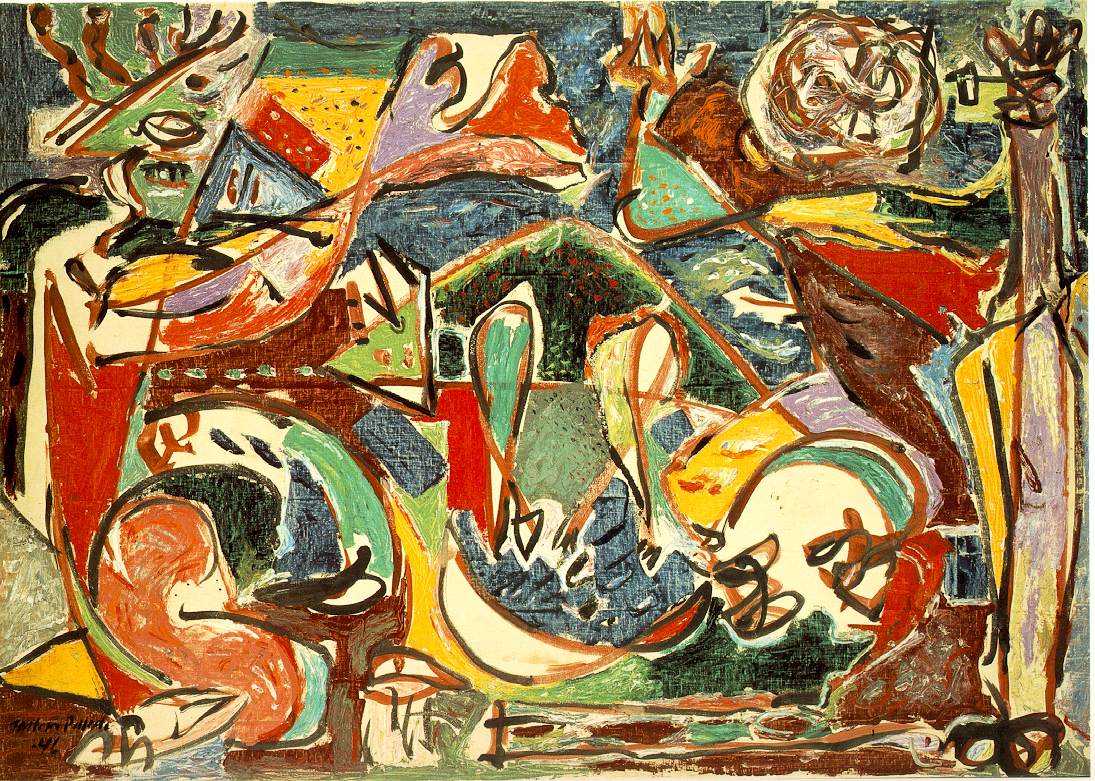
1946 (270 Kb); Oil on canvas, 59 x 84 in; The Art Institute of Chicago
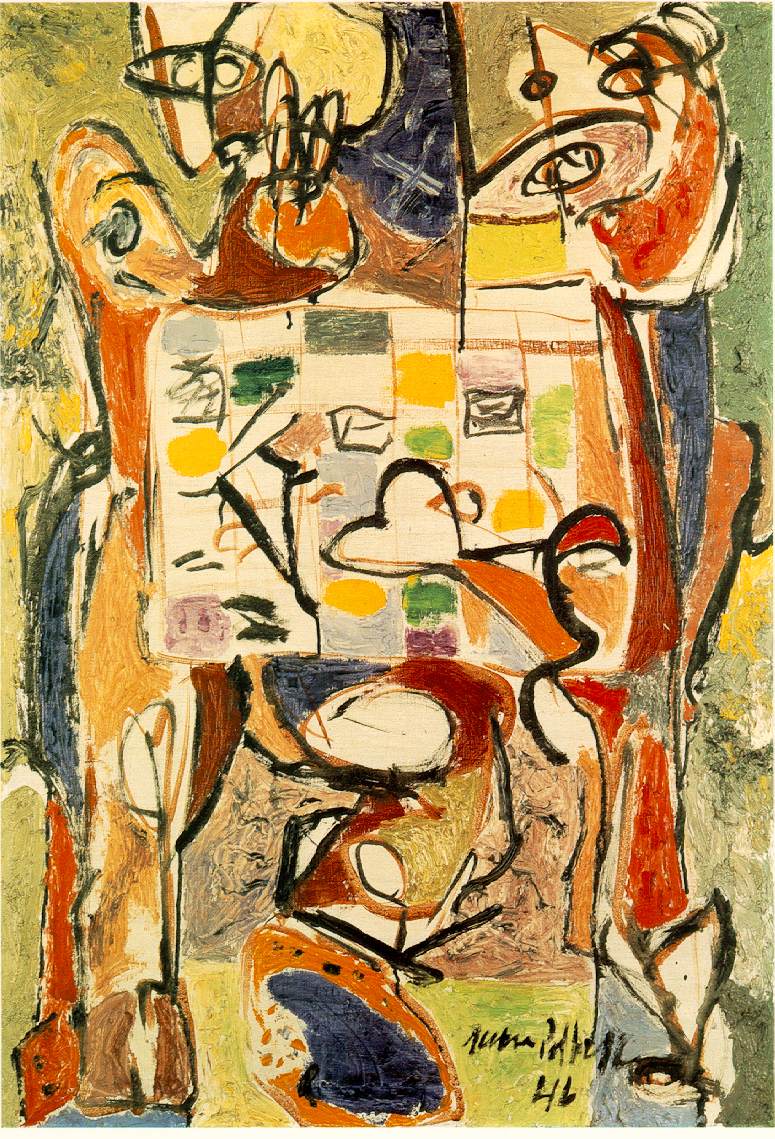
1946 (230 Kb); Oil on canvas, 40 x 28 in; Collection Frieder Burda, Baden-Baden
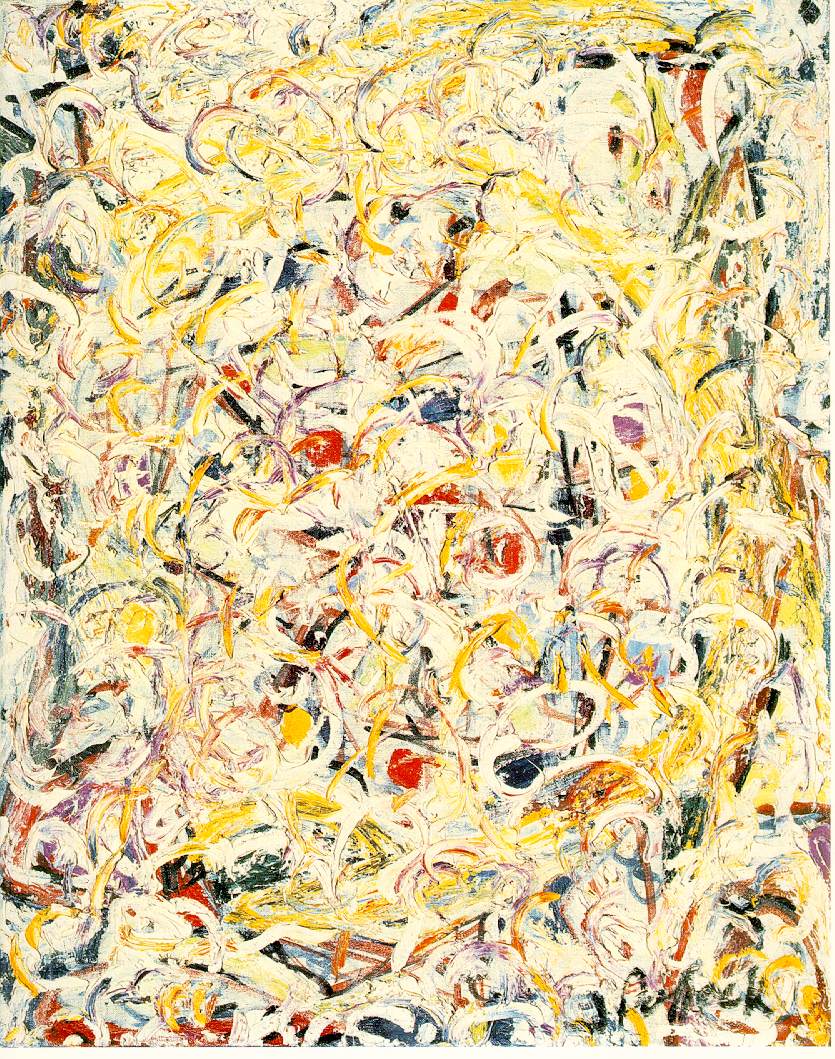
1946 (280 Kb); Oil on canvas, 30 1/8 x 24 1/4 in; The Museum of Modern Art, New York
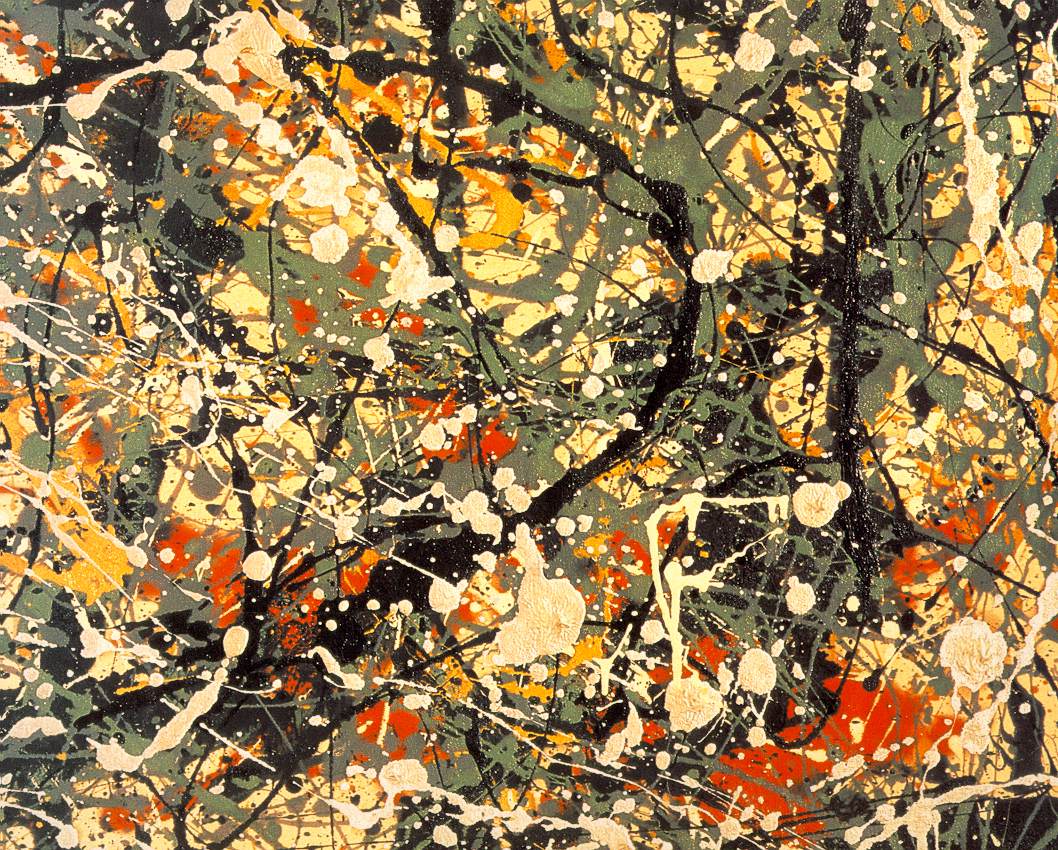
1949 (280 Kb); Oil, enamel, and aluminum paint on canvas; Neuberger Museum, State University of New York
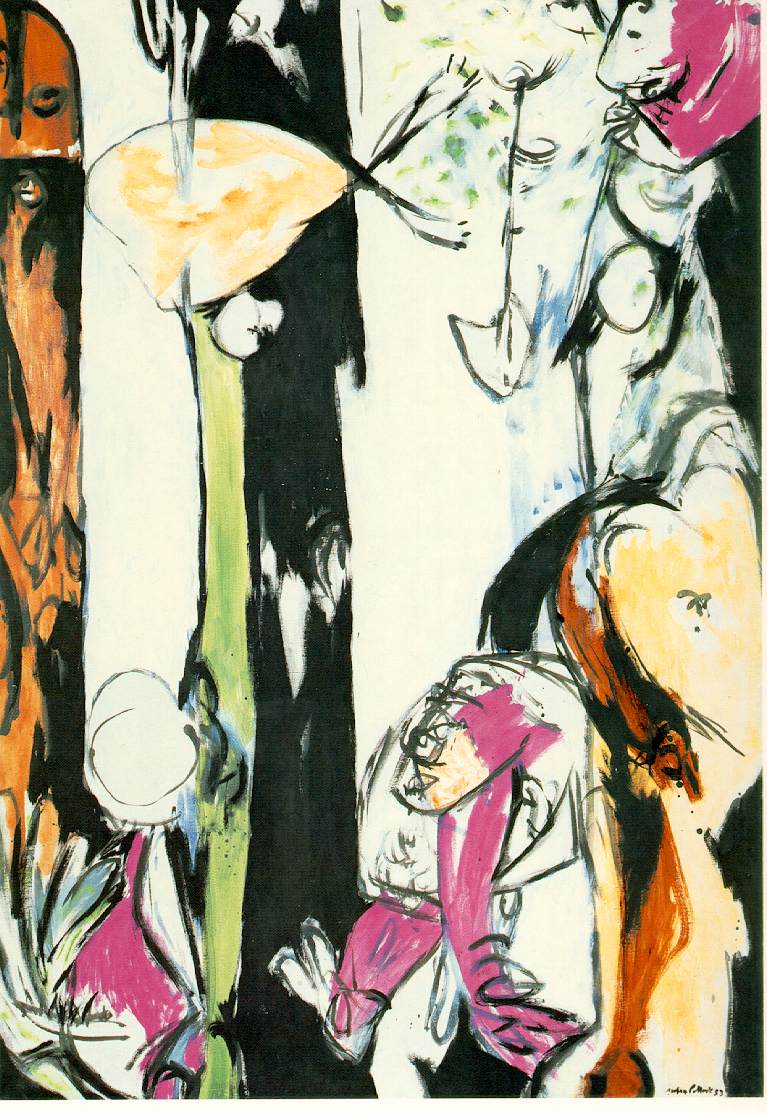
1953 (150 Kb); Oil on canvas, 84 1/4 x 58 in; The Museum of Modern Art, New York
During the 1950s Pollock continued to produce figurative or quasi-figurative black and white works and delicately modulated paintings in rich impasto as well as the paintings in the new all-over style. He was strongly supported by advanced critics, but was also subject to much abuse and sarcasm as the leader of a still little comprehended style; in 1956 Time magazine called him `Jack the Dripper'.
By the 1960s, however, he was generally recognized as the most important figure in the most important movement of this century in American painting, but a movement from which artists were already in reaction (Post-Painterly Abstraction). His unhappy personal life (he was an alcoholic) and his premature death in a car crash contributed to his legendary status. In 1944 Pollock married Lee Krasner (1911-84), who was an Abstract Expressionist painter of some distinction, although it was only after her husband's death that she received serious critical recognition.
It was Jackson Pollock who blazed an astonishing trail for other Abstract Expressionist painters to follow. De Kooning said, ``He broke the ice'', an enigmatic phrase suggesting that Pollock showed what art could become with his 1947 drip paintings.
It has been suggested that Pollock was influenced by Native American sand paintings, made by trickling thin lines of colored sand onto a horizontal surface. It was not until 1947 that Pollock began his ``action'' paintings, influenced by Surrealist ideas of ``psychic automatism'' (direct expression of the unconscious). Pollock would fix his canvas to the floor and drip paint from a can using a variety of objects to manipulate the paint.
The Moon-Woman Cuts the Circle (1943; 109.5 x 104 cm (43 x 41 in)) is an early Pollock, but it shows the passionate intensity with which he pursued his personal vision. This painting is based on a North American Indian myth. It connects the moon with the feminine and shows the creative, slashing power of the female psyche. It is not easy to say what we are actually looking at: a face rises before us, vibrant with power, though perhaps the image does not benefit from labored explanations. If we can respond to this art at a fairly primitive level, then we can also respond to a great abstract work such as Lavender Mist. If we cannot, at least we can appreciate the fusion of colors and the Expressionist feeling of urgency that is communicated. Moon-Woman may be a feathered harridan or a great abstract pattern; the point is that it works on both levels.
Conrad Botha
Although he has been painting all his life, Conrad Botha started his career as a professional artist in 2002. After a long and successful career in the corporate environment where he worked for some of the biggest broker firms in the world, he returned to his first love, art.
From the very beginning Conrad Botha always was innovative, but his breakthrough only came after his works and ideas was published in Culture magazine. This was the first time the general public was introduced to his art and the art movements that he started namely Generalism, Architecturism, and Television Impressionism.

He has been waiting for an hour and still no sign of her
|
Minutes before the chase |
The chase part 1 |
The chase part 2 |
His most recent works consists mainly out of landscapes. These landscapes represent what he calls “Analytical Generalism.” He refuses to classify these painting as anything but Generalism. These paintings originated from a vast amount of sketches and photographs he made, while on road trips especially
One of the things that distinguishes his art, from that of anyone else’s is his believe that the unique name given to a painting is just as important as any brush stroke. Unlike artists like Mark Rothko which stated that silence is so accurate, Conrad Botha believes that although he does not disagree with Rothko, the impact of a the right name for a painting has a severe and powerful effect on the viewer.
|
Who is she? |
I think she only likes me for my money |
I have to go, something just came up. |
At first glance of his landscapes one is struck by the extreme use of color and light, yet this does not diminish the feel of both realism and surrealism radiated from the paintings. This is most probably due to the fact that he uses almost the full value hue, of any color, he uses on his color plane. Another observation one could make is his inclusion of man-made objects such as motor vehicles. Conrad Botha is one of the view artists in the world that can do this without diminishing the elegance of a landscape painting.
|
Cars and a bus in |
I wonder what he really wants? |
Disco ball: Tonight we are going to party like it is 1999 (Television Impressionism) |
In a question what his art means his reply was as follows and I quote: “An artist is shaped by the environment, and sometimes the artist have an impact in shaping the environment. But the main focus for me is still to make a painting that must have an impact on the viewer both on visually and emotionally. Visually, I try to make an impact by my use of color, brush stroke and the composition. Emotionally, the name I give to the painting is as important as any brush stroke I make, to give the person an idea what I was thinking when I looked at the painting. But I also have an ulterior motive and that is to promote the idea of Generalism as a widely recognized art movement. Hopefully within a few years the word Generalism will be used as a term when people talk about art.”
|
Fig 2: Initial stages for “Make a wish and it will come true” (Television Impressionism) As anyone can see this picture was painted directly from a paused video signal. Although the final result can be compared to that of an abstract painting, the painting was done in an impressionistic style. |
Fig 3: Make a wish and it will come true (Television Impressionism) “This is the result of the experiment, and consists basically out of slabs of different colors similar to that on the television screen. The name was given only after I completed the painting, as it represented something reminiscent to a rainbow, and as a child I always made a wish when I saw a rainbow.” |
Here is an excerpt from notes Conrad Botha made regarding Genralism:
I founded Generalism as an art movement, mainly because there are too many paintings in existence that cannot be defined.
Generalism includes all art ever created, in the past and in the future. Therefore, all art that cannot be; or has not been yet defined as art, within an art movement, can be regarded as Generalism.
However when it is possible to narrower define a painting, like for instance an Impressionist painting by Cézanne, this art movement classification supersedes Generalism, and the painting will be known as an Impressionist painting.
Looking at the definition of the word, general (relating to or covering all instances: not limiting in meaning: not specific) there are many examples of artist all over the world that create art just for the sake of art without any specific movement or statement in mind. These are classic examples of Generalism.
Regarding my own art, I am first and foremost a Generalist. In the spirit of Generalism I paint what I see, what I know, what I don't see and also what I do not know. As the founder of Generalism I declare that there are no rules in Generalism, any means necessary to apply paint to a surface in a sensible way can be and shall be used. The only rule to Generalism is that there are no rules. Generalism includes all art, and are not just limited to paintings.
Manifesto for Generalism
1. Generalism, is art, for the sake of art.
2. All art is Generalism, unless it is narrower defined in another art movement.
3. Whenever art cannot be explained, or defined by the artist or by somebody else, it will be regarded as Generalism.
4. Therefore Generalism unites all art.
5. The onus, therefore rest on the creator, or observer, to explain, or to prove that a particular piece of art should not be regarded as Generalism.
6. Generalism comes down to the fact, that even if an artist has nothing to say, he/she must say it in order to prevent their work to be classified as Generalism.
|
Big business as usual in Yellow (Architecturism) |
|
Die trein na Matjiesfontein (Generalism) |
Conrad Botha is one of a few artists taking art forward. His innovations in art, both the theoretical and visual aspects of it, are very highly regarded.


The 4 Elements of Superstroke
As most people who has been following the Superstroke Art Movement knows is that the manifesto written for Superstroke is as follows:
1. Paintings should be executed using expressive even violent brushstrokes on at least some part of the picture.
2. Should a photograph be used for a figurative painting, the objection should not be Photorealism, but Expressionism.
3. If mediums such as pen, pencil, etc are used, the pen and pencil strokes must at least be overly expressive for it to be considered a Superstroke picture.
4. Paintings can be executed in both the abstract and figurative.
5. Subject matters such as
6. Collage, Stencil and Calligraphy may be used for impact.
7. The concept, Art for the sake of art, does not apply in Superstroke. In Superstroke it is art for the sake of Superstroke, as the artist must always strive for paintings rich in texture, or excessive brush or pencil strokes.
Superstroke consists out of 4 elements, namely The Stylized Image, Non Representative Abstraction, Realism and Combination. All of these elements are of equal importance, and make out the total collection of images in Superstroke. There has been a notion Superstroke should consolidate and focus on only one of the four elements, instead embracing all of them. Several discussions later and it was decided although it means more work, The Superstroke Movement will still embrace all four of these elements. Superstroke is extremely complex, and it seems that it will become even more so as time goes on.
In order to achieve the goals of Superstroke, namely to produce paintings to take art forward, it is important for the Superstroke Art Movement to incorporate all the elements of modern art.
Superflat started what will be a key point in a lot of Art Movements going forward, and that is to incorporate texture as a key element of the movement.


.jpg)
.JPG)
.JPG)
.jpg)
.jpg)


 Full Fathom Five


