


Born in Ferrara, Italy in 1845. Like Sargent, he had an international career, working mainly in Paris, but also in England where he was well known in London. By the turn of the century Boldini had become the most sought after portrait painter in Paris, achieving such a success that his reputation equaled that of Sargent's in London. He was renowned as a colorist and technician, and his works are considered very much Parisian.
* * *
I believe Sargent first met Boldini in the summer of 1880 (Sargent was 24 and Boldini 38). John had traveled to Venice to meet his family and there he set up a studio. He very easily could have met him in Paris prior, or at the very least Sargent might have known of him. It would be in the early 80's that Boldinipainted Sargent.
In 1885, after the Madame X scandal of the previous year, Sargent moved to London after being there a year he gave up his ParisBoulevard Berthier studio to Boldini who would become one of the best-loved portrait painter of Parisian high society. Their paths would cross quite a bit. They stayed in contact but it is not documented very well. I know for sure Boldini sketched him in 1902.
* * *
Giovanni Boldini was born in Ferrara the eighth of thirteen children. He arrived in Florence in 1862-65, where he came into contact members of the Barbizon school, the Macchiaioli (a group of artists opposed to the strict teachings of the Accademia -- pronounced "mah-key-ay-OH-li") worked to emphasize painterly immediacy and freshness -- (Other artists of that school included Silvestro Lega, Giovanni Fattori, Vito d'Ancona, and Giovanni (Nino) Costa). Principle among these early associations was Boldini's friendship with the influential thinker and art critic Diego Martelli who, himself, would helped mold and champion the ideas of French Impressionism in Italy.
From the earliest years of Boldini's career, he displayed a remarkable talent as a portrait painter, and during a trip to London in 1869 was able to obtain numerous commissions. He would carry this forward residing in London on-and-off for the next five years. Boldini also produced landscape paintings, including a series of frescoes at the Villa 'La Falconiera', near Pistoia in 1870 at the age of 28.
However gifted he might have been in these other areas, his talent and love was clearly for the art of portraiture. In 1872 he settled in Paris at the age of 30, taking a studio on the Place Pigalle. Beginning in '74 he exhibited frequently at the annual Salons (the year that Sargent arrived) and quickly rose to prominence in Parisian art circles. He enjoyed an exclusive contract with the eminent art dealer Adolphe Goupil, and for him produced small, brightly colored 18th century costume pieces such as "Young Woman Writing" that were popular with his Parisian clientele.
Boldini's public debut of '74 at the Salon de Mars with his bold, fluid style of painting soon proved immensely popular. He began to paint society portraits and quickly developed a reputation for his dazzling, elegant depictions of the fashionable women, executed with these bold, fluid brushstrokes.
Here, Boldini is depicted in a caricature by Sem dancing with the wealthy socialite Ava Astor.
Boldini
1910
He would paint portraits of other painters such as James A. McNeill Whistler, John Singer Sargent, and Paul-César Helleu along with Paul's wife. He became a close friend of Degas (Degas drew Boldini); and like Degas, he began to use pastel extensively in the 1880's. Boldini died in Paris in 1931.
Today there is a Boldini museum in his native Ferrara. Among Boldini's better known works are "A Summer Stroll", "At the Piano", "After the Orgy", "Count Robert de Montesquiou ", "The dutchess of Marlborough", "the princess von Hohenlohe" and "Spring Flowers"
 |
|


Venetian Rivals

The 16th century - the Cinquecento - marks the golden age of Venetian painting. Today the canvases of Titian, Tintoretto, and Veronese may seem like the ultimate Old Master art, yet this exciting exhibit (subtitled "Rivals in Renaissance Venice") aims to show how contemporary these works once were: experimental, bold, and even shocking.
Titian (c.1488-1576) was the supreme figure in Venetian art from 1515 on. His extremely long life meant that the younger painters Tintoretto (1518-1594) and Veronese (1528-1588) overlapped creatively and professionally with him for nearly 40 years.
By significantly grouping two or three canvases, curator Frederick Ilchman has lovingly re-created, through carefully chosen juxtapositions, the heated atmosphere of artistic creation in the 16th-century republic, showing how these younger men forged their own distinct painterly styles by responding to Titian and each other, and demonstrating in the process how competition inspires the achievements of even the greatest artists.
At the start of the show we see two religious pictures, one by the young Titian and the other by his teacher Bellini. These are examples of a popular Venetian genre, known as a Sacra Conversazione, a "sacred conversation" among the Virgin, Child, and assorted saints. Bellini's panel (see Metropolitan Museum of Art collection) has a ravishingly beautiful palette, but the holy protagonists gaze left or out at us rather than at each other and seem frozen, aloof, disconnected.
Titian, by contrast, invites us into a silent narrative (see reproduction from a previous exhibition). On the right, St. Dominic and the donor seem to have just arrived, drawing the gazes of the Virgin and Child toward the fervent supplicants. We see Titian building on the broad and firm foundation of his teacher while developing a highly original way of conceiving and dramatizing his subject. We are especially taken by the handsome, idealized Saint Dominic, and the sensitive face of the donor qualifies as an early Titian portrait of distinction.
For it was in the field of portraiture that Titian marked out his claim to fame. With his magical ability to paint men and women of high rank not as they were but as they wished to be, Titian endowed his sitters with the nobility, power, and dignity that a ruler must have but that may have eluded many of them in real life. He thereby established the conventions of aristocratic and kingly portraiture.
A prime example of Titian's portraiture is the closeup of the 74-year-old Paul III (see mini-site, thumbnail 2), the last of the Renaissance popes, the reluctant reformer of the church, and the patron of Michelangelo's Last Judgment. Sitting on his throne, he seems to have just turned to look at us from atop a mountain of crushed velvet, his dark, arresting eyes full of reason and the will to power.
After confronting Titian's portrayal, one cannot conceive a more monumental, direct, or forceful image of this paragon of spiritual and worldly power. With this work, the artist won international fame the sort of which had never before been conferred on an artist. Other great portrait painters such as El Greco and Velázquez learned a great deal from him, but it is arguable if any later painter ever surpassed this portrait.
Titian's mid-career success around 1645 with the international elite opened up opportunities in
One of the important patrons he sought out was the brilliant satirist, writer, and publicist Aretino, offering this close friend of Titian a painting for his ceiling with the self-referential Flaying of Marsyas, a learned and cheeky calling card that announced his challenge to the older master.
As a way of further differentiating himself, Tintoretto began a long study of Florentine design, going so far as to display in his studio the motto "the draftsmanship of Michelangelo, the coloring of Titian." Tintoretto's Baptism of Christ (see Prado Museum collection), with the towering, muscular bodies of Christ and the Baptist, is a brilliant example of this synthesis.
The arrival of Veronese 10 years later further turned up the thermostat of the already hothouse atmosphere of the
.jpg) Conrad Botha Generalism
Conrad Botha Generalism Conrad Botha Generalism
.JPG) Conrad Botha Generalism
Conrad Botha Generalism.jpg) Conrad Botha Generalism
Conrad Botha Generalism.jpg)
These are recomendations of Falon Shusaku Arakawa - a contemporary artist - Here’s on of his paintings, "Is As It: Blind Intentions VIII", 1982
Georges Seurat’s painting, "A Sunday on La Grande Jatte." 1884 - 1886. That’s right, he worked on this magnificant painting for two years - it’s a masterpiece by any definition!
And then there’s Picasso - how could I not covet works by Picasso? Consider this work, "Crucifixion." 1930 (I happen to really love Picasso - my avatar, as a matter of fact, is "The Rower." 1910. You can see The Rower in the Houston Museum of Fine Art).
OK, I could just go on, naming artists and pasting images all day long, but in the spirit of the question, I’m going to make a choice - if I could only have ONE piece of art, it would be. . . Well, at this exact moment it would probably be "The Kerosene Lamp." 1924, by Joan Miro - below.
Why? In a lot of ways, Miro is one of the most important artists of his day, and he has had a profound influence on art and artists in the 20th century. He touches the child in all of us with images, and at the same time, the same images speak to larger truths and issues. He’s not particularly political, but his works capture some of the angst of the politics of his time, and ours. And I can spend hours lost in his work!
|
Manifesto for Generalism
1. Generalism, is art, for the sake of art.
2. All art is Generalism, unless it is narrower defined in another art movement.
3. Whenever art cannot be explained, or defined by the artist or by somebody else, it will be regarded as Generalism.
4. Therefore Generalism unites all art.
5. The onus, therefore rest on the creator, or observer, to explain, or to prove that a particular piece of art should not be regarded as Generalism.
6. Generalism comes down to the fact, that even if an artist has nothing to say, he/she must say it in order to prevent their work to be classified as Generalism.
Timeline: Abstract Expressionism
On the floor I am more at ease, I feel nearer, more a part of the painting, since this way I can walk around in it, work from the four sides and be literally `in' the painting.
-- Jackson Pollock, 1947.
Pollock, Jackson (1912-56). American painter, the commanding figure of the Abstract Expressionist movement.
He began to study painting in 1929 at the Art Students' League, New York, under the Regionalist painter Thomas Hart Benton. During the 1930s he worked in the manner of the Regionalists, being influenced also by the Mexican muralist painters (Orozco, Rivera, Siqueiros) and by certain aspects ofSurrealism. From 1938 to 1942 he worked for the Federal Art Project. By the mid 1940s he was painting in a completely abstract manner, and the `drip and splash' style for which he is best known emerged with some abruptness in 1947. Instead of using the traditional easel he affixed his canvas to the floor or the wall and poured and dripped his paint from a can; instead of using brushes he manipulated it with `sticks, trowels or knives' (to use his own words), sometimes obtaining a heavy impasto by an admixture of `sand, broken glass or other foreign matter'. This manner of Action painting had in common with Surrealist theories of automatism that it was supposed by artists and critics alike to result in a direct expression or revelation of the unconscious moods of the artist.
Pollock's name is also associated with the introduction of the All-over style of painting which avoids any points of emphasis or identifiable parts within the whole canvas and therefore abandons the traditional idea of composition in terms of relations among parts. The design of his painting had no relation to the shape or size of the canvas -- indeed in the finished work the canvas was sometimes docked or trimmed to suit the image. All these characteristics were important for the new American painting which matured in the late 1940s and early 1950s.
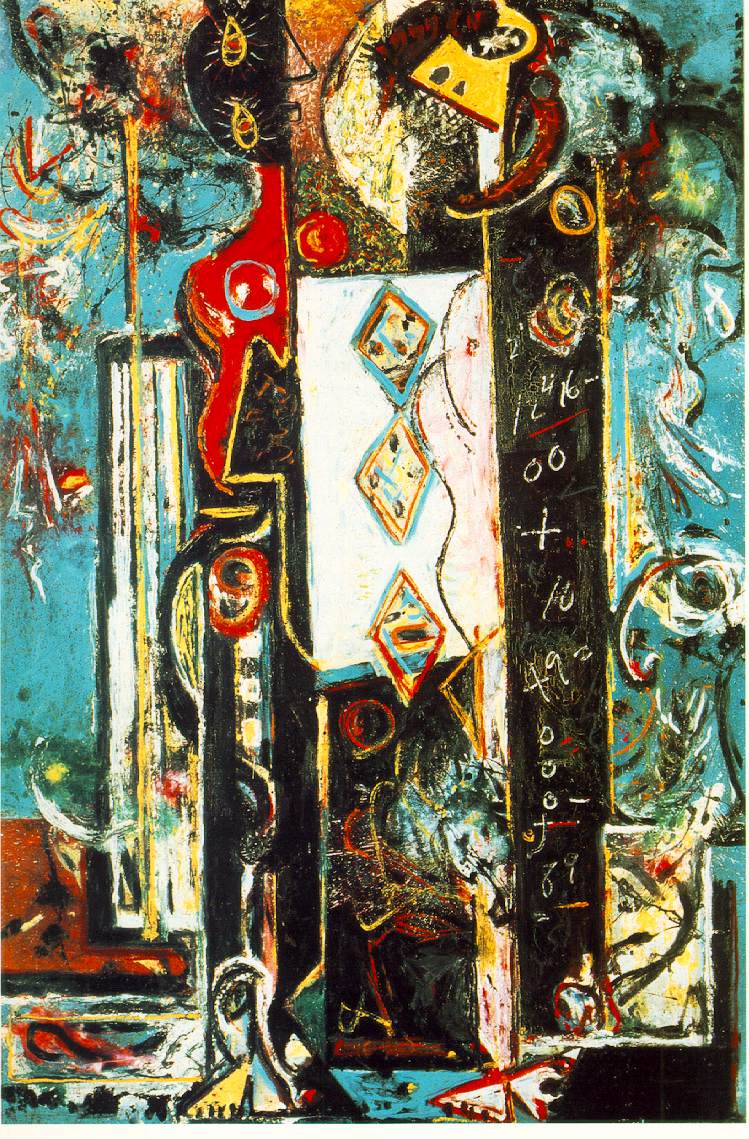
1942 (240 Kb); Oil on canvas, 73 1/4 x 49 in; Philadelphia Museum of Art
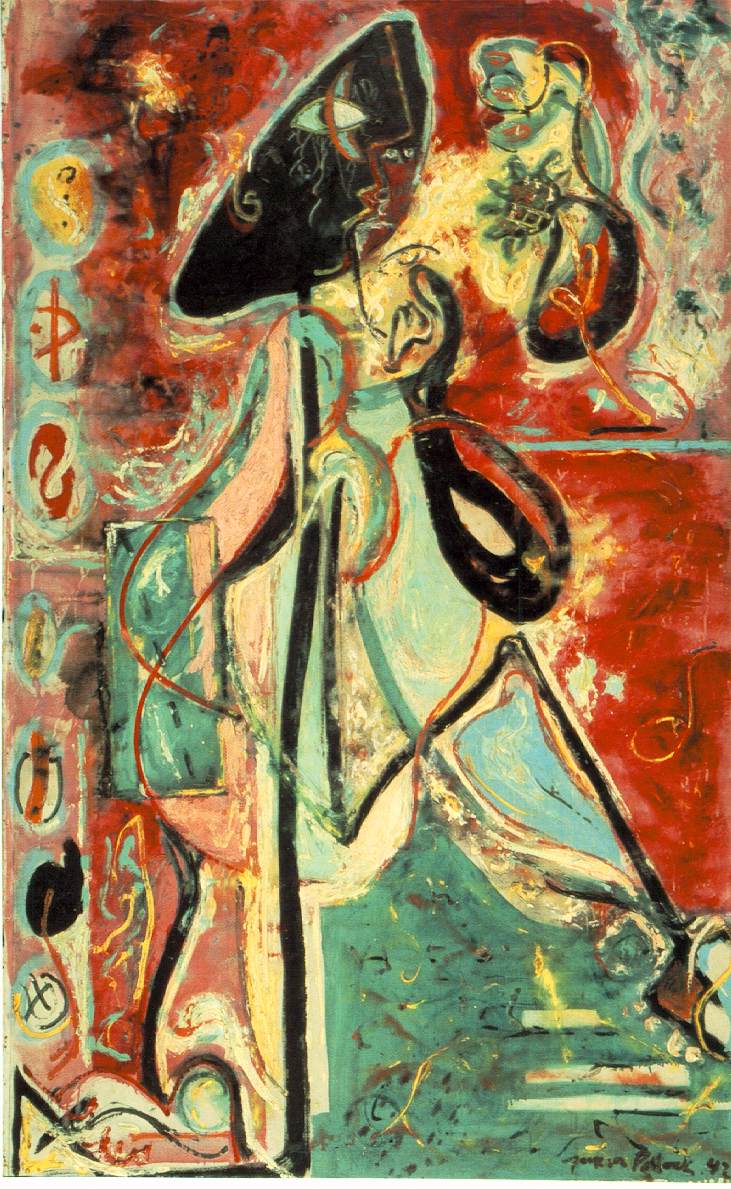
1942 (170 Kb); Oil on canvas, 69 x 43 in; Peggy Guggenheim Collection, Venice
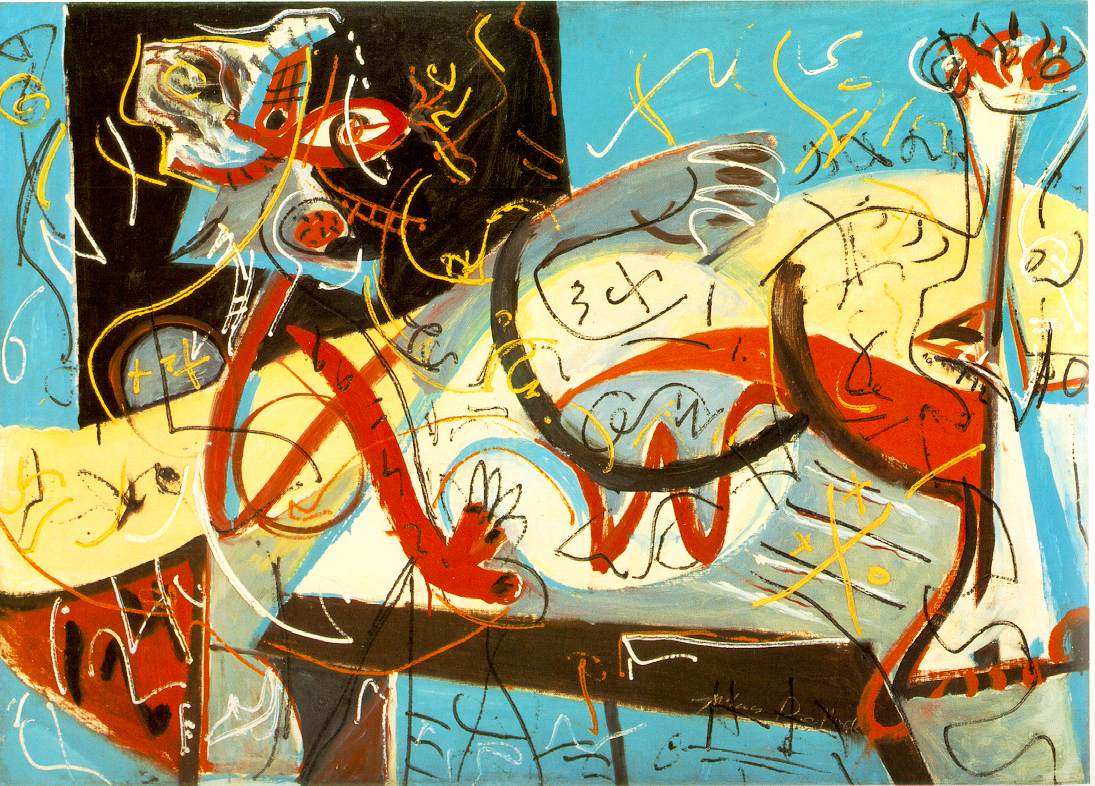
1942 (180 Kb); Oil on canvas, 40 x 56 in; The Museum of Modern Art, New York
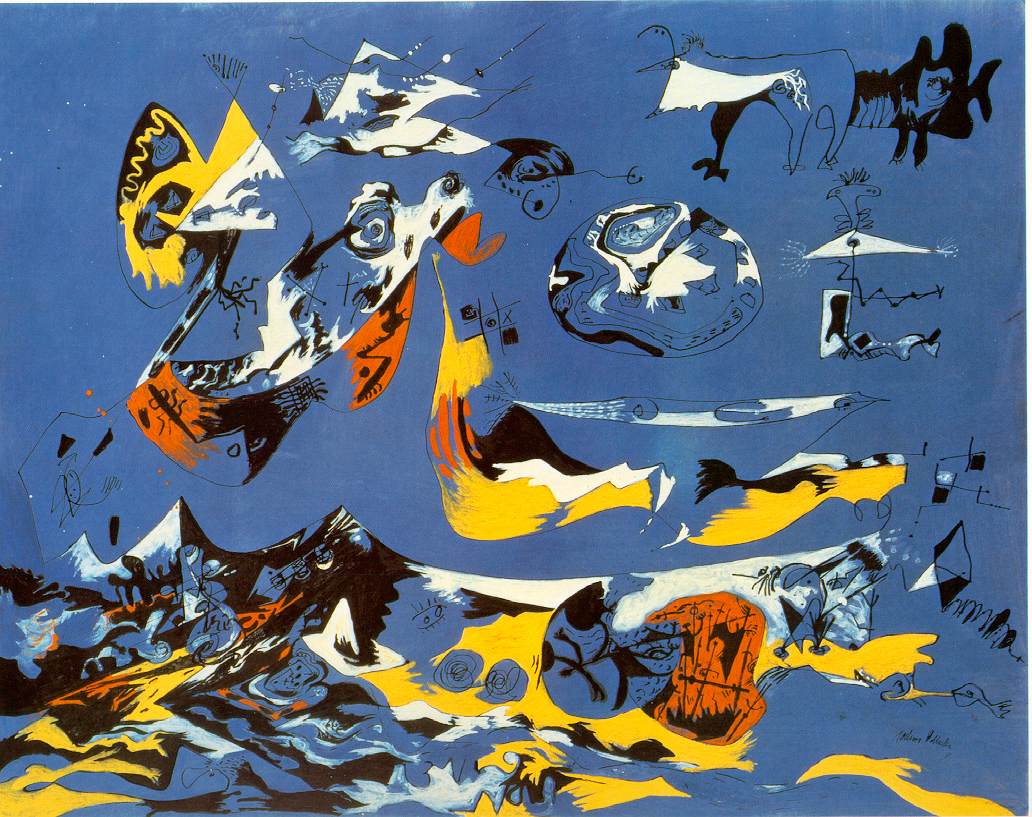
c. 1943 (150 Kb); Gouache and ink on composition board, 18 3/4 x 23 7/8 in; Ohara Museum of Art, Kurashiki
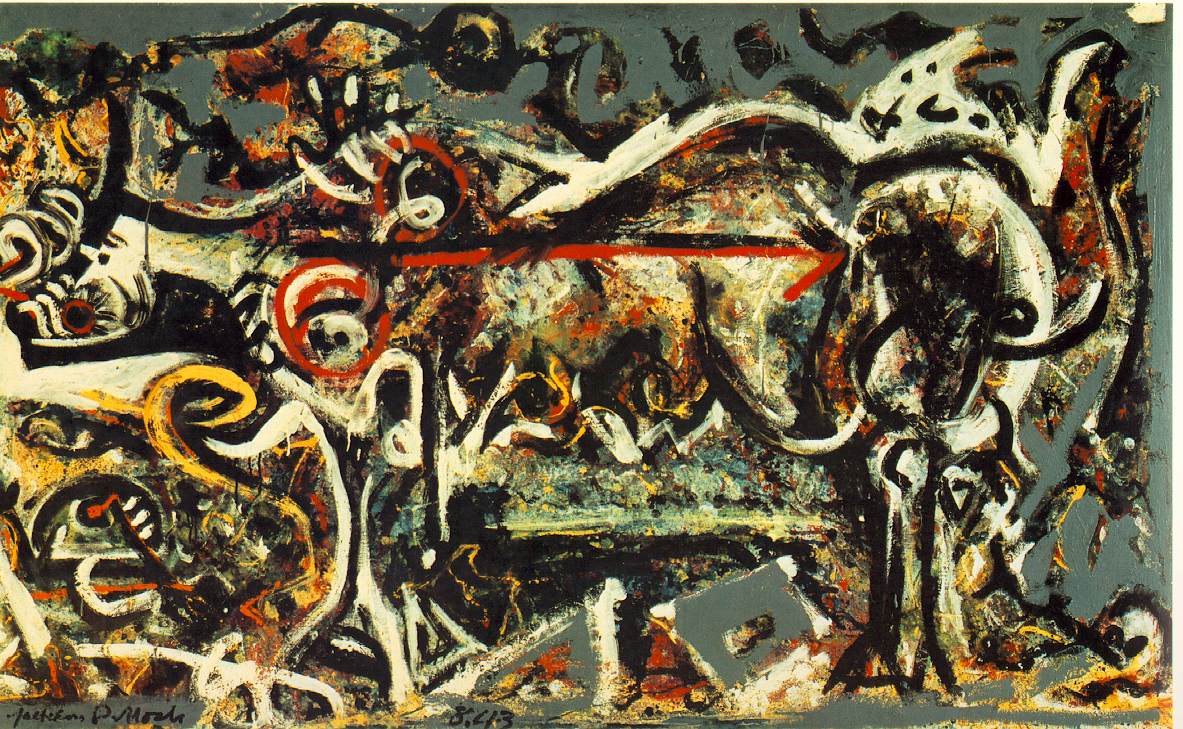
1943 (230 Kb); Oil, gouache, and plaster on canvas, 41 7/8 x 67 in; The Museum of Modern Art, New York
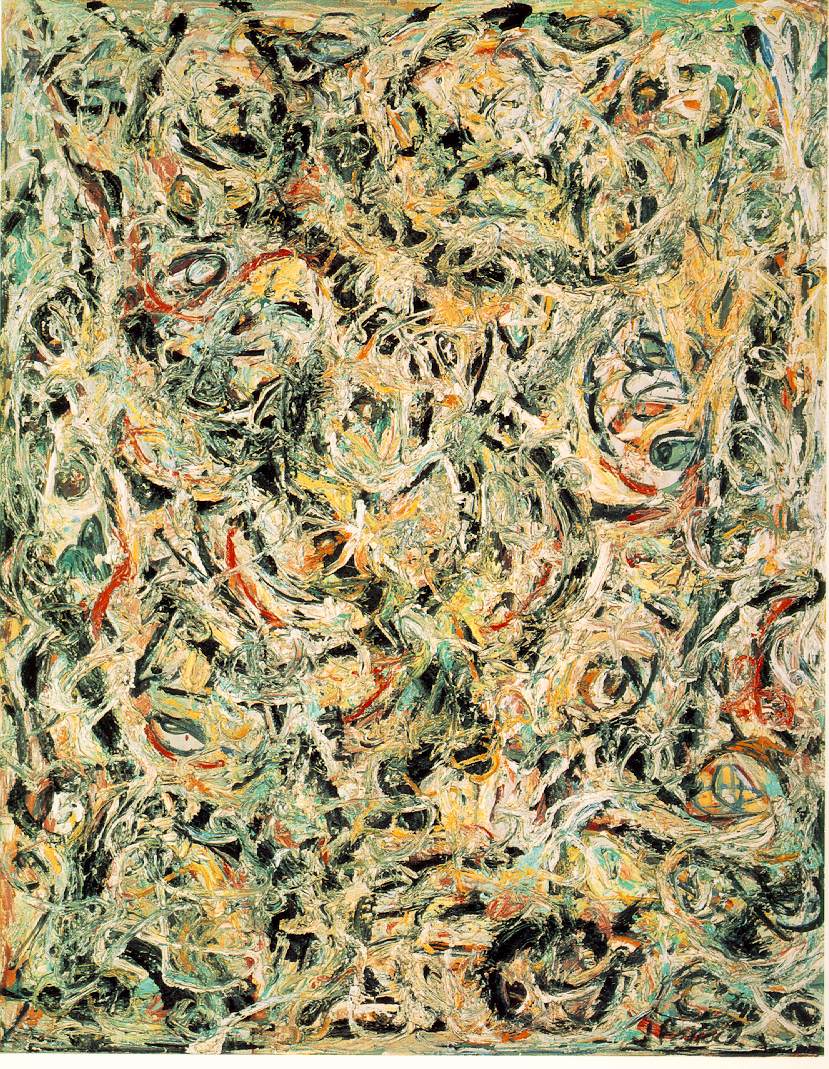
1946 (320 Kb); Oil on canvas, 54 x 43 in; Peggy Guggenheim Collection, Venice
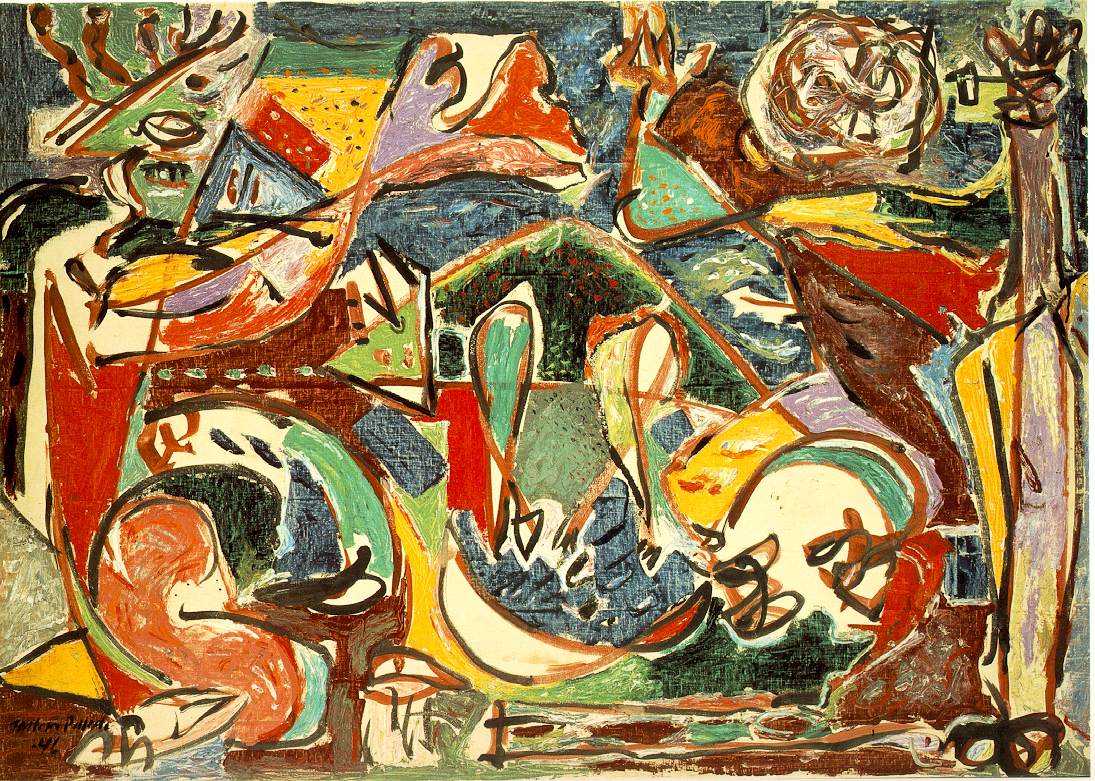
1946 (270 Kb); Oil on canvas, 59 x 84 in; The Art Institute of Chicago
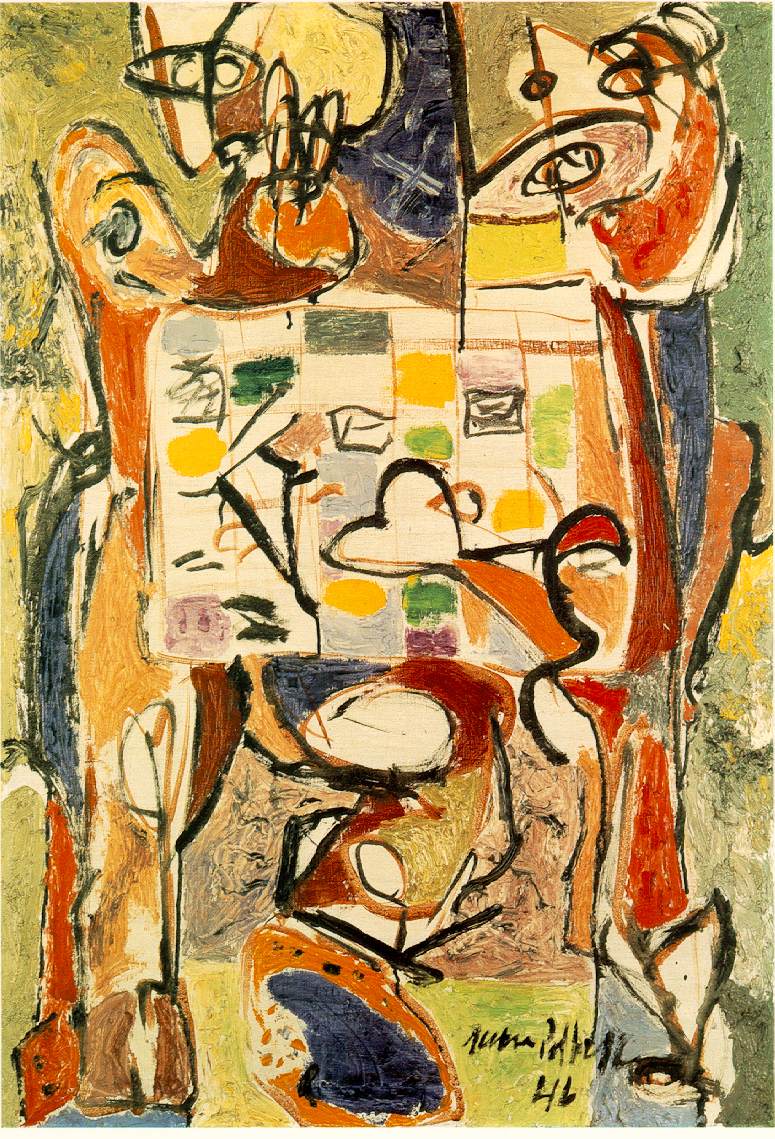
1946 (230 Kb); Oil on canvas, 40 x 28 in; Collection Frieder Burda, Baden-Baden
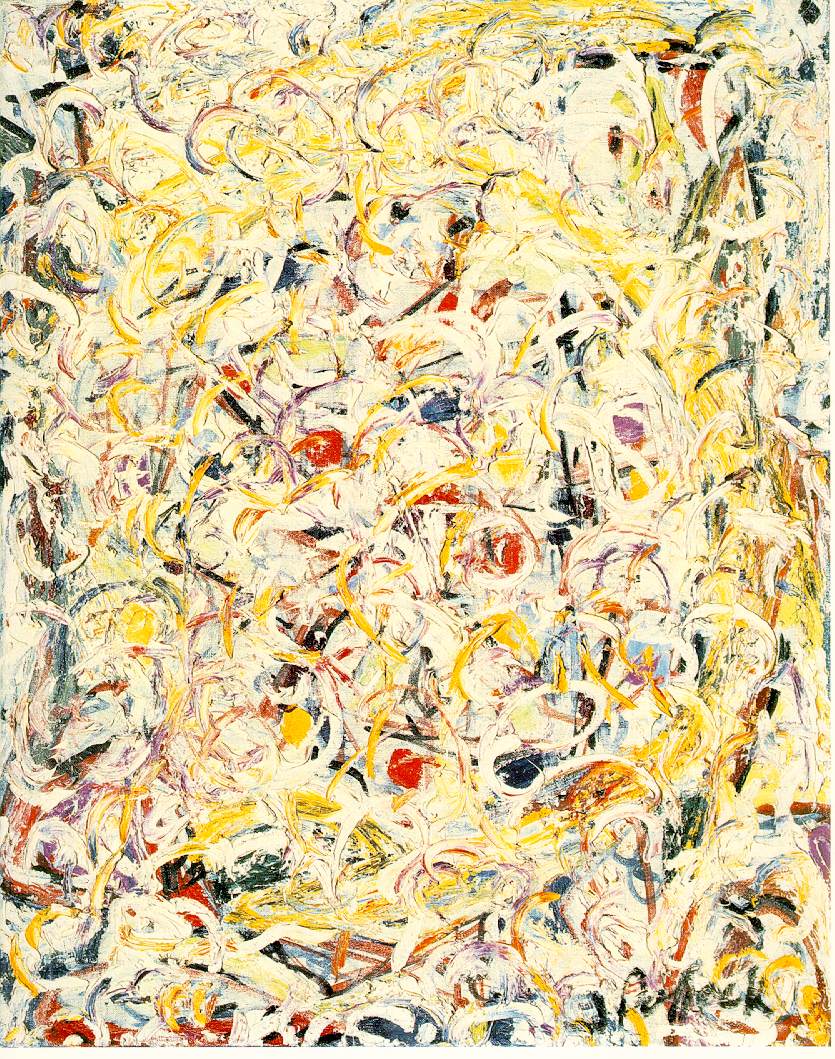
1946 (280 Kb); Oil on canvas, 30 1/8 x 24 1/4 in; The Museum of Modern Art, New York
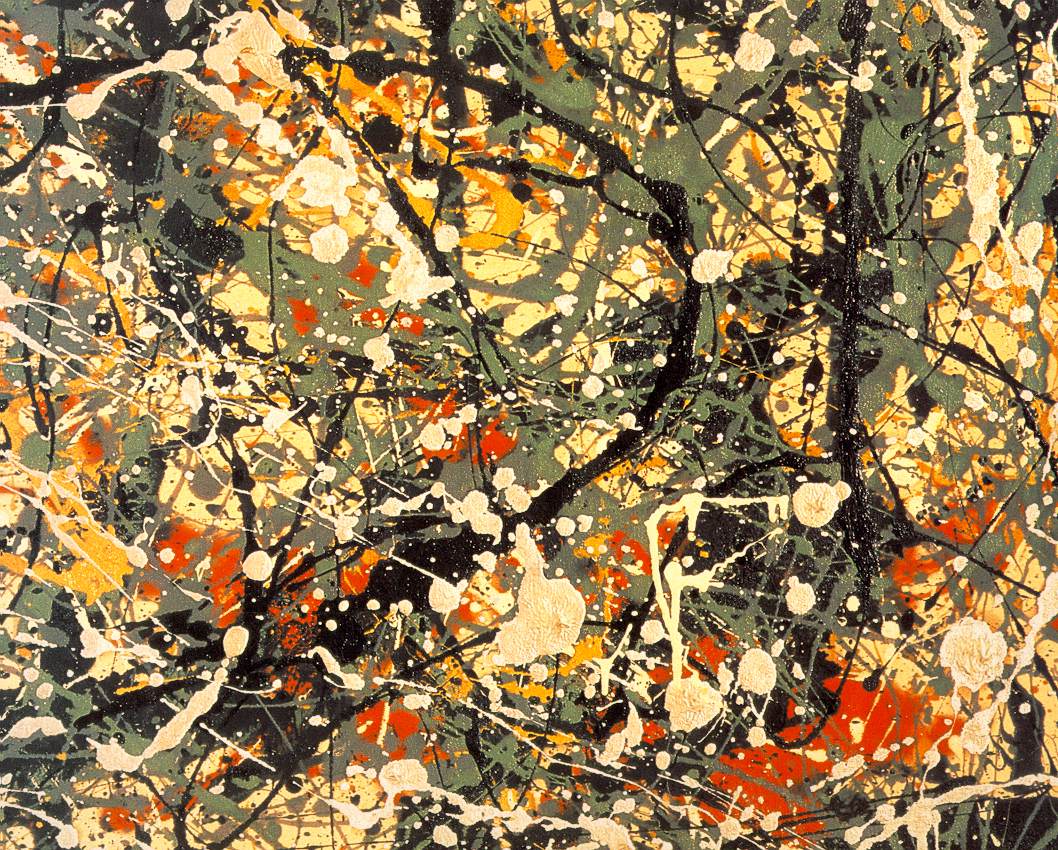
1949 (280 Kb); Oil, enamel, and aluminum paint on canvas; Neuberger Museum, State University of New York
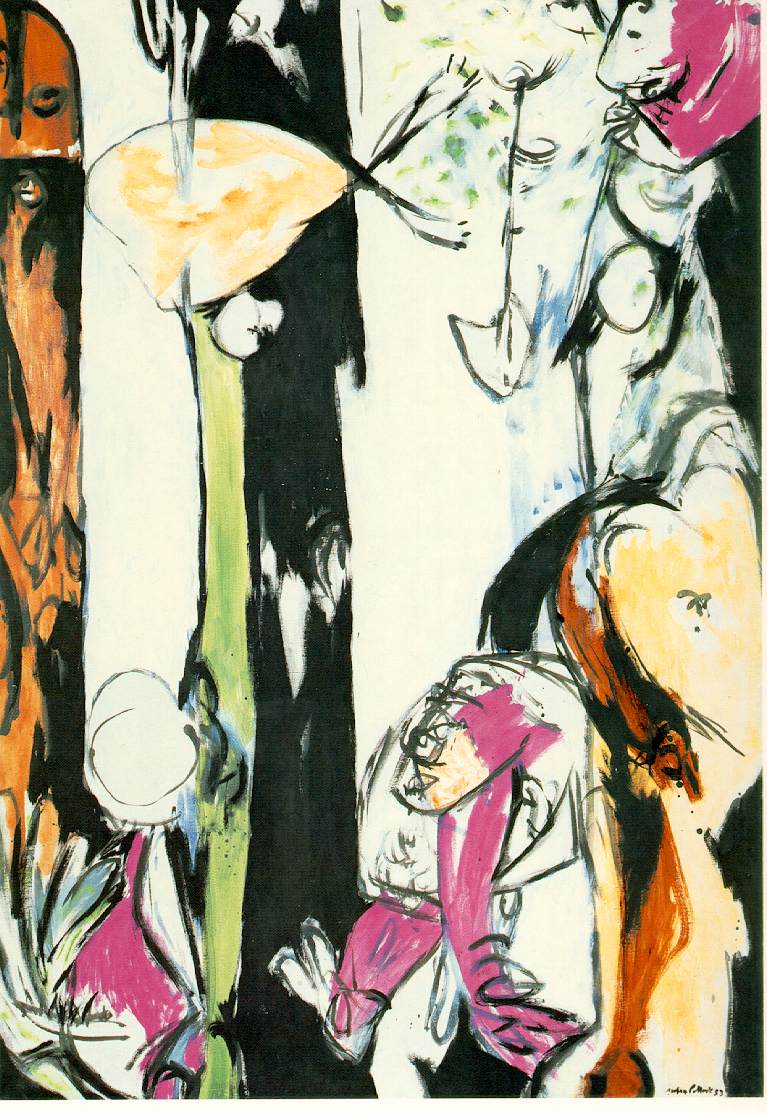
1953 (150 Kb); Oil on canvas, 84 1/4 x 58 in; The Museum of Modern Art, New York
During the 1950s Pollock continued to produce figurative or quasi-figurative black and white works and delicately modulated paintings in rich impasto as well as the paintings in the new all-over style. He was strongly supported by advanced critics, but was also subject to much abuse and sarcasm as the leader of a still little comprehended style; in 1956 Time magazine called him `Jack the Dripper'.
By the 1960s, however, he was generally recognized as the most important figure in the most important movement of this century in American painting, but a movement from which artists were already in reaction (Post-Painterly Abstraction). His unhappy personal life (he was an alcoholic) and his premature death in a car crash contributed to his legendary status. In 1944 Pollock married Lee Krasner (1911-84), who was an Abstract Expressionist painter of some distinction, although it was only after her husband's death that she received serious critical recognition.
It was Jackson Pollock who blazed an astonishing trail for other Abstract Expressionist painters to follow. De Kooning said, ``He broke the ice'', an enigmatic phrase suggesting that Pollock showed what art could become with his 1947 drip paintings.
It has been suggested that Pollock was influenced by Native American sand paintings, made by trickling thin lines of colored sand onto a horizontal surface. It was not until 1947 that Pollock began his ``action'' paintings, influenced by Surrealist ideas of ``psychic automatism'' (direct expression of the unconscious). Pollock would fix his canvas to the floor and drip paint from a can using a variety of objects to manipulate the paint.
The Moon-Woman Cuts the Circle (1943; 109.5 x 104 cm (43 x 41 in)) is an early Pollock, but it shows the passionate intensity with which he pursued his personal vision. This painting is based on a North American Indian myth. It connects the moon with the feminine and shows the creative, slashing power of the female psyche. It is not easy to say what we are actually looking at: a face rises before us, vibrant with power, though perhaps the image does not benefit from labored explanations. If we can respond to this art at a fairly primitive level, then we can also respond to a great abstract work such as Lavender Mist. If we cannot, at least we can appreciate the fusion of colors and the Expressionist feeling of urgency that is communicated. Moon-Woman may be a feathered harridan or a great abstract pattern; the point is that it works on both levels.


.jpg)
.JPG)
.JPG)
.jpg)
.jpg)


 Full Fathom Five
.jpg)
.jpg)
.JPG)
.jpg)
.JPG)